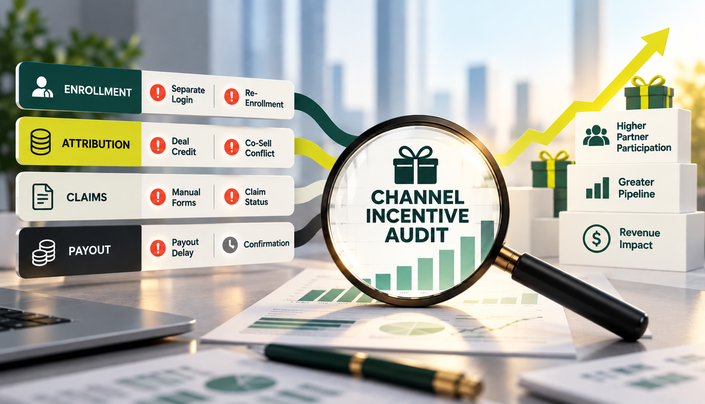
This audit is built for partner marketing leaders who suspect that gap exists but haven’t pinned down where. It’s eight yes-or-no questions across the four places where channel incentive management typically breaks down: enrollment, attribution, claims, and payout. Answer honestly, count your yeses, and read your score at the end to identify which operational areas need immediate attention.
What Is a Channel Incentive Audit?
A channel incentive audit is a structured review of how well a vendor’s partner incentive program, SPIFFs, MDF, rebates, or referral commissions actually converts into partner participation and pipeline. It measures the program in practice: where partners drop off between enrollment and payout, and why.
Most channel incentive audits focus on incentive structure and payout size. This one focuses on friction: the operational gaps in enrollment, attribution, claims, and payout that cause partners to disengage regardless of how the incentive itself is designed. The eight questions below walk through each of those four areas.
How to Use This Channel Incentive Audit
Go question by question. Each one has a straightforward yes-or-no answer, based on how your program actually works today, not how it was designed to work. Tally your yeses as you go. At the end, your score points to whether friction is a minor issue for your program or the primary one.
Enrollment Friction in Channel Incentive Programs
Enrollment is the first place partners disengage, often before the program itself has had a chance to prove its value. These two questions test how much effort it takes just to get in, and to stay in as circumstances change.
1. Can Partners Enroll Without a Separate Login?
Every additional login a partner needs before they can participate is a partner who doesn’t finish enrolling.
- What a “no” costs you: if joining means creating a new account in a separate portal, checking your enrollment numbers against your total partner base will usually explain a lot of your participation problem on its own.
- Common failure mode: enrollment lives somewhere disconnected from the CRM, deal workflow, or partner portal the partner already checks daily. The incentive itself might be well designed. It just never gets in front of the partner in a place they were already going to be.
2. Does a Tier Change Trigger Re-Enrollment?
Tier structures exist to reward performance, but if crossing a tier threshold resets a partner’s enrollment status, the reward mechanism is creating its own friction.
- What a “no” costs you: a partner who just earned their way into a better tier shouldn’t have to file paperwork to claim it. When they do, the promotion feels like homework instead of a reward, and some partners let it pass rather than deal with it.
- Common failure mode: enrollment status lives in a static record instead of updating automatically when a partner’s activity crosses a tier threshold. The system already knows the partner qualified. It just doesn’t act on that knowledge without a manual step.
Attribution Friction in Deal Registration Programs
Attribution is where programs win or lose trust. If a partner can’t be confident their work will be recognized, everything downstream, claims, payout, renewal, starts to erode.
3. Can Deal Registration Rules Prove Attribution?
If the answer depends on a partner filling out a form describing their own involvement after the fact, you don’t have attribution. You have a claim you’re choosing to trust.
- What a “no” costs you: self-reported attribution is exactly where disputes start, and where partners begin to suspect the program won’t pay out fairly even when it will.
- Common failure mode: the incentive is tied to a partner’s account of what happened rather than a system event. A deal reg incentive program that ties payout directly to the deal registration incentive program event, rather than a partner’s own account, turns attribution from a conversation into a fact the system already knows.
4. Do Deal Registration Rules Prevent Channel Conflict on Co-Sell Deals?
Co-sell and alliance-driven deals are where attribution problems get expensive.
- What a “no” costs you: any deal that doesn’t fit a one-partner assumption becomes a manual reconciliation project, and manual reconciliation is where credit disputes live.
- Common failure mode: partners burned by an unresolved credit dispute once tend to stop registering deals they’re unsure will be recognized cleanly, which quietly shrinks your funnel in a way that’s hard to trace back to this specific cause.
Claims Friction in Channel Incentive Software
Even well-attributed incentives get abandoned if collecting them takes too much effort. These two questions test what happens after a partner has already earned the payout.
5. Does Claiming a Payout Still Require a Manual Form?
Every manual step between qualifying for an incentive and actually claiming it costs you a percentage of the partners who qualified.
- What a “no” costs you: this is the gap between an incentive that’s automatic to earn and one that’s manual to collect, and it’s one of the more fixable sources of friction on this list because it’s entirely process, not architecture.
- Common failure mode: a deal-triggered incentive that still requires a follow-up claim form has only solved half the problem. Thinking through how to incentivize deal registration specifically comes back to this question more than any other.
6. Does Claim Status Add to Partner Portal Fatigue?
Silence reads as rejection.
- What a “no” costs you: a partner who files a claim and hears nothing for three weeks doesn’t assume the process is just slow. They assume the claim was lost, denied, or not worth following up on, and they’re less likely to file the next one.
- Common failure mode: status updates happen by email thread instead of a visible state. If checking status means emailing a program manager and waiting for a reply, you don’t have a claims process. You have a queue nobody outside your team can see into.
Payout Friction in Deal Registration Incentive Programs
The final stretch, actual payout, is where a program either confirms it works or quietly convinces a partner it doesn’t.
7. How Long Between Qualifying Action and Payout?
The link between the action and the reward weakens with every day that passes between them.
- What a “no” (or “too many”) costs you: an incentive earned in January and paid in April doesn’t feel connected to the deal that earned it anymore, even if the quarterly cycle makes sense operationally.
- Common failure mode: payout runs on a fixed calendar cycle instead of triggering off the qualifying event. This is one of the areas where deal registration best practices and payout design overlap directly: the closer the payout sits to the qualifying event, the more the incentive actually shapes behavior in real time instead of just settling a balance after the fact.
8. Do Partners Get Automated Payout Confirmation?
A partner who has no idea their claim is progressing has no reason to believe the program is working, even when it’s working exactly as designed.
- What a “no” costs you: silence between approval and payout gets read as the program not working, regardless of whether it actually is.
- Common failure mode: no notification layer exists between qualification and payout. A simple automated confirmation when a claim is approved does more for perceived program reliability than almost anything else on this list, and it’s usually the cheapest fix to build.
What Effective Channel Incentive Management Actually Requires
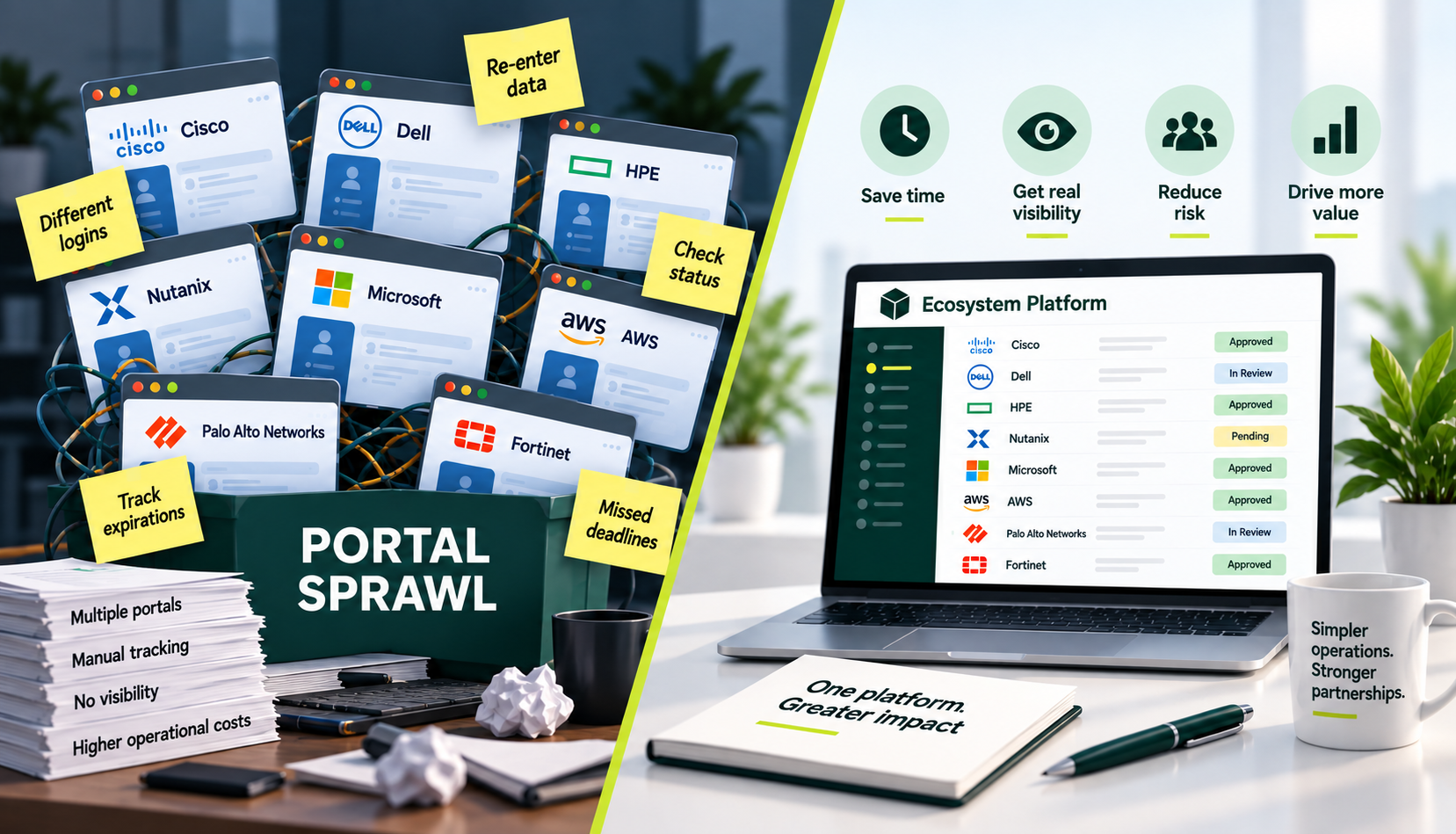
Fixing this one gap at a time rarely closes it. The eight friction points above aren’t separate problems. They’re symptoms of one underlying issue: the incentive program and deal registration living in different systems, with nothing flowing automatically between them.
Closing that gap for good requires two things:
- Attribution living inside the same system a partner already works in, so incentive eligibility comes from the deal event itself, not a claim filed after the fact.
- That holding true across every vendor relationship a partner carries, since partners default to whichever program asks the least of them.
Vartopia approaches this by keeping deal registration and incentive attribution inside the same Salesforce-native system a partner already uses, so credit comes from the deal record itself rather than a form the partner fills out afterwards.
For partners working with multiple vendors, that’s one system instead of a separate login and process per vendor. The aim is simple: make participating in your program the easiest thing a partner does all week. Whether your program is close to that today is exactly what your audit score will show.
What Your Channel Incentive Audit Score Means
- 6 to 8 yes answers: friction isn’t your primary problem. If participation is still low, look at incentive design and payout amounts instead.
- 3 to 5 yes answers: friction is quietly capping your participation, even if the program looks fine from the outside. This is the most common band, and it’s usually invisible until someone runs an audit like this one.
- 0 to 2 yes answers: friction is very likely your primary problem, not the incentive itself. No incentive redesign will fix this until you close the operational gaps.
This is a directional self-check, not a validated diagnostic instrument. Treat your score as a starting point for a conversation, not a final verdict.
What to Do When Your Channel Incentive Score Is Low
Don’t start by redesigning the incentive. Start with attribution and claims, specifically deal registration rules and how cleanly they tie a partner’s action to a payout. Those two categories tend to compound: weak attribution makes claims harder to trust, and hard-to-trust claims are the ones partners stop filing.
Fix that link first, whether the incentive in question is a SPIFF, a rebate, or market development funds. The enrollment and payout issues usually get easier to solve once you have, because you’re no longer fixing four problems that all trace back to the same root cause.
The Real Cost of Ignoring Channel Incentive Friction
None of the friction points in this audit are dramatic on their own. A separate login here, a manual form there, a three-week silence on a claim status. Each one looks minor in isolation, which is exactly why they survive so long inside a program that otherwise looks well-designed. Partners don’t file a complaint about friction. They just quietly stop participating, and the program’s own reporting rarely tells you why.
The audit above makes that “why” visible before it shows up as a participation number you can’t explain. If question three exposed a gap, look at it first, since attribution tends to be the root from which the other seven friction points grow.

See how deal registration and incentives work together inside one Salesforce-native system. Talk to an expert.