That’s usually how the mistake shows up too. Deal registration looks fine. Approvals are faster than they used to be. Everyone would call the program a success. Then partner-sourced revenue doesn’t move, and nobody can quite explain why, because the tool that’s working perfectly was never built to answer that question.
So which one does your program actually need? That comes down to where your program stands today, not which category sounds more impressive on a vendor call. There are a handful of clear signs that tell you exactly that, and this piece walks through all of them.
What Is Deal Registration Software?
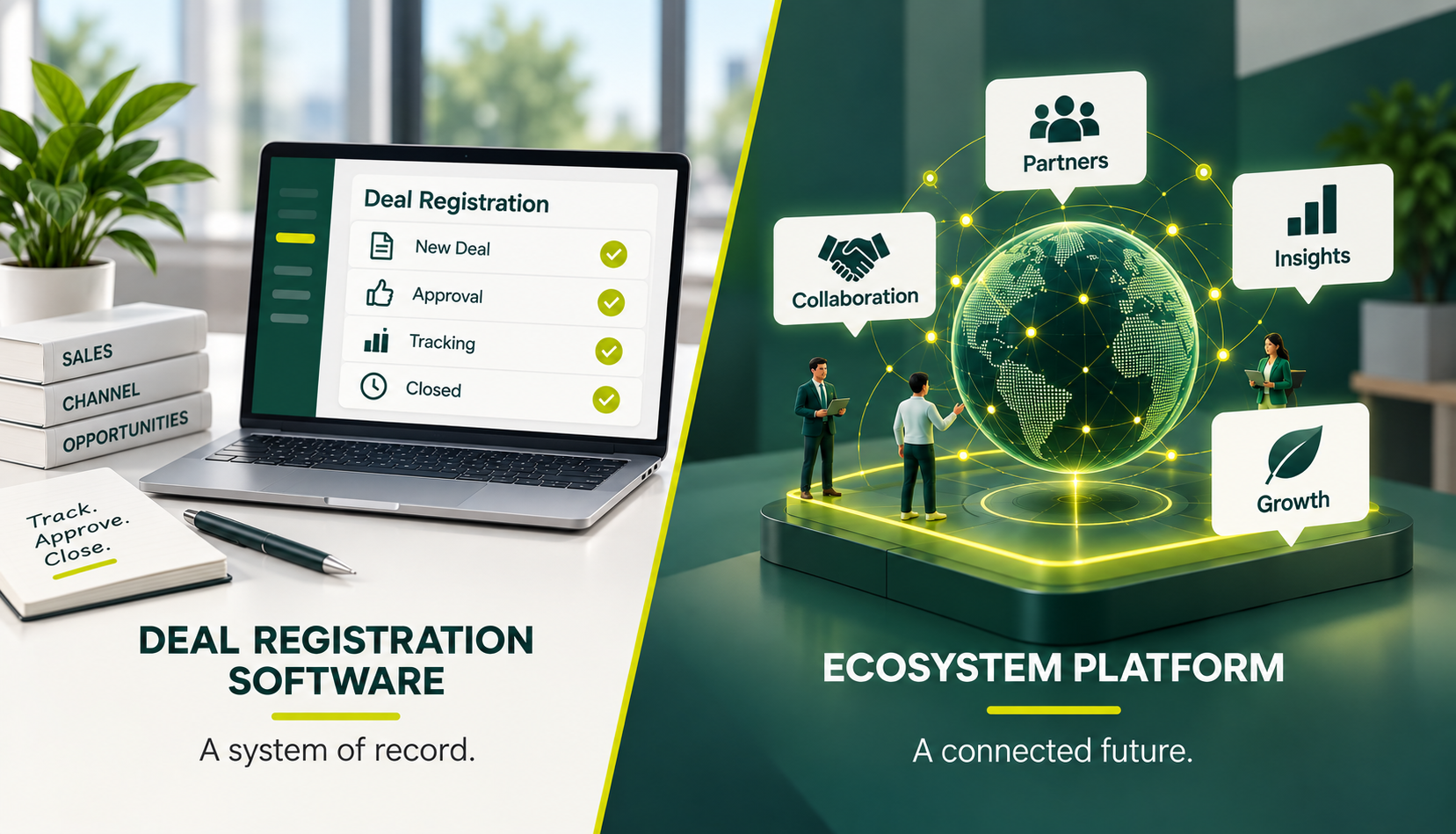
Deal registration software is a system of record for one specific job: letting partners submit an opportunity, routing it through an approval workflow, and tracking it until it expires or closes.
Done well, it protects partners from having a deal poached by a competitor or the vendor’s own direct sales team, and it gives vendors a clean audit trail.
This is foundational infrastructure, not a weak category. Most channel programs need it. The question isn’t whether you need deal registration. It’s whether registration alone is still answering the questions your program actually has.
Limitations of Deal Registration Software
A registration system tells you whether a deal got submitted. It doesn’t tell you:
- Whether a partner’s low close rate is a coaching problem or a fit problem
- Whether a competitor’s partner already has the relationship you’re chasing
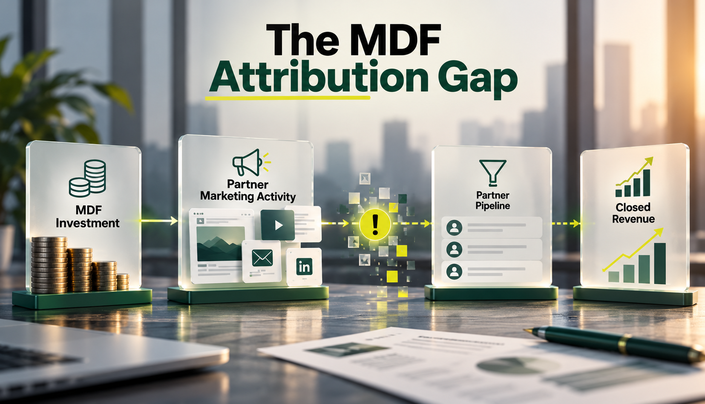
- Whether your marketing spend is actually converting to partner-sourced revenue
That’s not a flaw in the tools. It’s a scope limit. Single-vendor registration data can only ever answer single-vendor questions.
5 Signs You’ve Outgrown Deal Registration Software (Channel Program Checklist)
Not every program needs to jump straight to a full partner ecosystem platform. But if two or more of the patterns below sound familiar, it’s usually because your team is running channel management software built to log deals, not partner relationship management software built to run an ecosystem. Here’s how to tell which one your program actually needs.
1. Enablement Gap vs. Partner Gap
If a partner’s close rate with you is low, is that a training problem or a partner problem? Without a benchmark, you’re guessing. If you knew that same partner closes at 22% ecosystem-wide but only 3% with you, you’d know it’s your enablement, not their capability.
2. Late-Stage Deal Registration
If most of your registrations come in at quoting or ordering instead of at the opportunity stage, you’re finding out about deals well after the risk window that registration exists to protect against has already narrowed.
3. Multi-Vendor Deal Registration Challenges
Alliance and co-sell deals involving multiple partners and more than one vendor’s technology often mean re-entering the same opportunity into several disconnected systems, with no shared source of truth across vendors.
4. Channel Team Scaling Without Automation
If your channel team is growing just to keep pace with your partner network, that’s a sign the tooling is asking people to do work software should be absorbing.
5. Partner Relationship Visibility Gaps
If you can’t see which partners already have a closed-won relationship at a target account before your team reaches out, you’re recruiting and prioritizing partners blind.
If two or more of these sound familiar, the gap isn’t a deal registration problem. It’s a data problem no deal registration portal was built to solve, and exactly what a partner ecosystem platform is designed to close instead.
Partner Ecosystem Platform vs. Deal Registration Software: Key Differences
An ecosystem platform keeps everything deal registration software does and adds three functional layers on top:
- Discovery — surfacing which partners already have relationships at your target accounts, before you approach them
- Benchmarking — comparing a partner’s performance against ecosystem-wide norms, not just against your own program’s averages
- Attribution — tracing revenue and marketing spend through the full deal lifecycle, from registration to closed-won, not just at the point of submission
If you’ve been researching PRM software, you’ve likely come across Impartner. It’s one of the more established platforms in the category, built to handle onboarding, training, content delivery, and deal registration within your own partner program, and it does that well.
But if what you actually need goes beyond managing your program to understanding your ecosystem, that’s the gap Vartopia was built to close. Let’s put them side by side and see where each one actually earns its place in a channel program.
Vartopia vs. Impartner: Comparing Deal Registration and Ecosystem Capabilities
The overlap between these two platforms is real, but so is where they split. Start with what they share before looking at what separates them.
Where Impartner and Vartopia solve the same problem
Both platforms handle configurable deal registration, approval workflows, and partner performance tracking within a vendor’s own program. If your channel program only needs a single-vendor system of record, that overlap covers most of what you’d evaluate either platform for.
Vartopia vs. Impartner: Feature Comparison
| Capability | Impartner | Vartopia |
|---|---|---|
| Data foundation | Vendor-specific partner data within a single program instance | Live multi-vendor network: 150,000+ channel partners and 500,000+ partner contacts already transacting across 300+ vendor programs |
| Partner discovery | Not a published capability | Partner Explorer searches millions of de-identified historical transactions to surface which partners already close at a given account |
| Performance benchmarking | Partner scoring within your own program | Ecosystem Scorecard compares a partner’s close rate with you against their close rate across the entire ecosystem |
| AI enablement | AI-driven workflows for onboarding, training, and deal registration | Deal Coach auto-delivers content based on deal stage and activity, informed by cross-ecosystem deal patterns, not just your own program’s history |
| Architecture | Portal-based, integrates with CRM systems | Salesforce-native custom objects, no sync delays or middleware |
| Time to launch | Not published | Most programs go live in under two weeks |
The right choice depends on where your program actually is, not which platform has more rows checked.
If your channel program runs through a single vendor relationship, your partners aren’t juggling multiple vendor portals, and your biggest need is a clean, reliable system for submitting and approving deals, Impartner’s program-scoped approach is a well-matched, lower-complexity fit.
If your program involves multiple vendors, tiered or alliance partners, or you recognized two or more of the signals earlier in this post, the ecosystem-wide data Vartopia is built on becomes the more relevant fit, because those are exactly the problems single-program data can’t solve on its own.
Neither platform is the wrong choice in the abstract. The signals your program is actually showing should make the decision, not the other way around.
How to Choose Between a PRM and a Partner Ecosystem Platform
If your program has a handful of vendor relationships, low deal complexity, and no multi-vendor co-sell motion, a strong single-vendor PRM like Impartner is the right-sized answer. Don’t over-buy capability you don’t need yet.
If you’re managing multiple vendors, tiered partners, or alliance deals, and you recognized two or more signals above, the gap is costing you pipeline today, and it’s a data-architecture problem no amount of registration-workflow tuning will fix.

Ready to see whether your program has outgrown deal registration? Schedule a walkthrough with Vartopia.