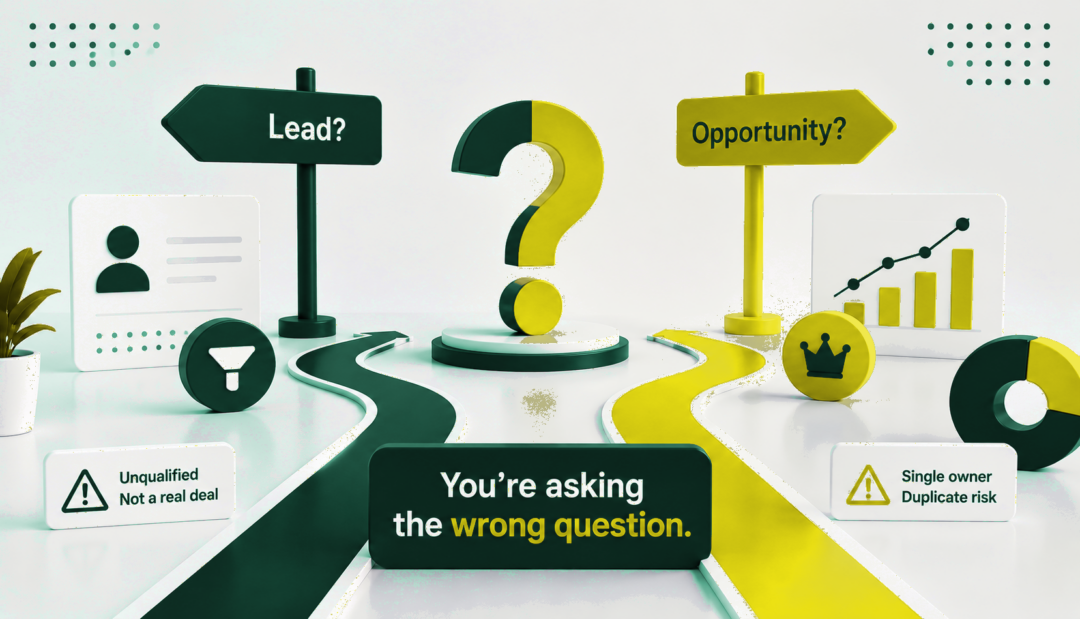
It feels like a technical question with a right answer. Both objects exist. Both technically work. Salesforce itself doesn’t pick a side.
So you either ask a consultant, find a 10-year-old blog post, or go with what your instinct says. The problem is the question itself.
A deal registration isn’t a Lead. It isn’t an Opportunity either. It’s a partner’s formal claim on a deal, and forcing it to become one of those standard objects is exactly where channel pipeline starts to break down. When you understand why that is, the Lead vs. Opportunity debate stops feeling like a configuration choice and starts looking like a category error.
What Salesforce Is Actually Saying When It Asks You to Choose
Before getting into where the Lead and Opportunity model fails for channel, it’s worth being precise about what those two objects actually do in Salesforce’s native design.
An Opportunity is that real deal. It requires an Account. It requires a Contact. It’s owned by a single person, sits in a pipeline, has a close date, and feeds revenue forecasting. Opportunity Stages reflect the internal sales process, not a partner’s claim or an approval workflow.
Both were built for a direct sales motion. A sales rep sources a lead, qualifies it, converts it to an opportunity, and closes it. One person, one process, one record.
A partner registering a deal doesn’t fit that motion. The partner isn’t in your Salesforce. They’re submitting a claim from the outside, often before an Account or Contact exists in your CRM, and often for a deal that another partner may also be pursuing. Neither object was designed with that scenario in mind.
Why Many Channel Teams Start With Leads (And When It Makes Sense)
The Lead model has a real case behind it, especially for programs running high submission volumes or just getting started.
- Leads can be queue-owned, so you don’t need to assign every registration to a named channel manager before anyone reviews it
- Lead Status picklist values are easy to customize into a registration workflow: New, Submitted, Approved, Denied
- No custom objects, no complex development
- Native Web-to-Lead captures registrations from a web form without building anything
For early-stage programs with limited RevOps bandwidth, this gets you operational fast
Where it falls apart:
- No native product line items. If approvals depend on knowing what products are being registered, you’re either building custom fields or handling it manually.
- Lead conversion adds friction. After approval, a channel manager has to convert the Lead to an Opportunity, match it to an existing Account, and find or create the right Contact. In practice, this step gets skipped, done inconsistently, or done weeks late.
- Pipeline data drifts. Once conversion is unreliable, your CRM stops reflecting reality before the deal is even active.
Why Some Teams Go Straight to Opportunities (And the Hidden Cost)
For more mature programs, Opportunities look like the cleaner answer.
- No intermediate conversion step
- Native product line items and revenue forecasting out of the box
- Separate record types for channel vs. direct sales means you can actually report on them independently
If your partner accounts are already in the CRM and you’re running lower-volume, high-value registrations, the Opportunity model gives you better data fidelity from day one.
The hidden cost shows up when two partners register the same deal.
Because an Opportunity is a single-owner record, you’re left with two bad options:
- Create two Opportunity records for the same deal, which doubles your pipeline
- Pick one partner’s registration and discard the other, which creates channel conflict
There’s also a submission problem worth calling out. Opportunities require an Account and Contact before they can be created. Partners often don’t have that information at registration time. Relax the requirement and your CRM fills with orphaned records. Push the burden onto the partner and your registration completion rate drops.
The Real Problem: A Registration Isn’t a Lead or an Opportunity. It’s a Claim
The Lead vs. Opportunity debate assumes deal registration is a type of CRM record. It isn’t.
A deal registration is a partner’s formal claim on a sales opportunity. It has:
- Its own approval logic
- Its own expiration rules
- Its own status lifecycle
Its own relationship to the partner who filed it
That lifecycle runs parallel to the Opportunity’s pipeline stages. It isn’t the same thing.
Here’s what actually happens when a deal gets registered:
The partner submits a claim: we are working this deal; protect us. The vendor reviews it and approves or denies it. The registration can expire, get returned for more information, or be resubmitted. The Opportunity, meanwhile, moves through its own stages: Qualification, Proposal, Negotiation, Closed. Those two timelines interact, but they don’t mirror each other.
When you force the registration to become a Lead or an Opportunity, you collapse those two timelines into one record. The Opportunity stage becomes a proxy for registration status, which it was never designed to be. Or registration status gets buried in a custom field on the Lead, invisible to your pipeline reporting.
The failure mode is clearest when two partners register the same deal:
| Scenario | What happens |
|---|---|
| Lead model | Two Lead records for the same company |
| Opportunity model | Two Opportunity records for the same deal |
| Either way | Pipeline counts that deal twice |
Your channel managers are manually reconciling before every QBR. Your VP of Sales is asking why the Salesforce number doesn’t match what’s coming from the partner side.
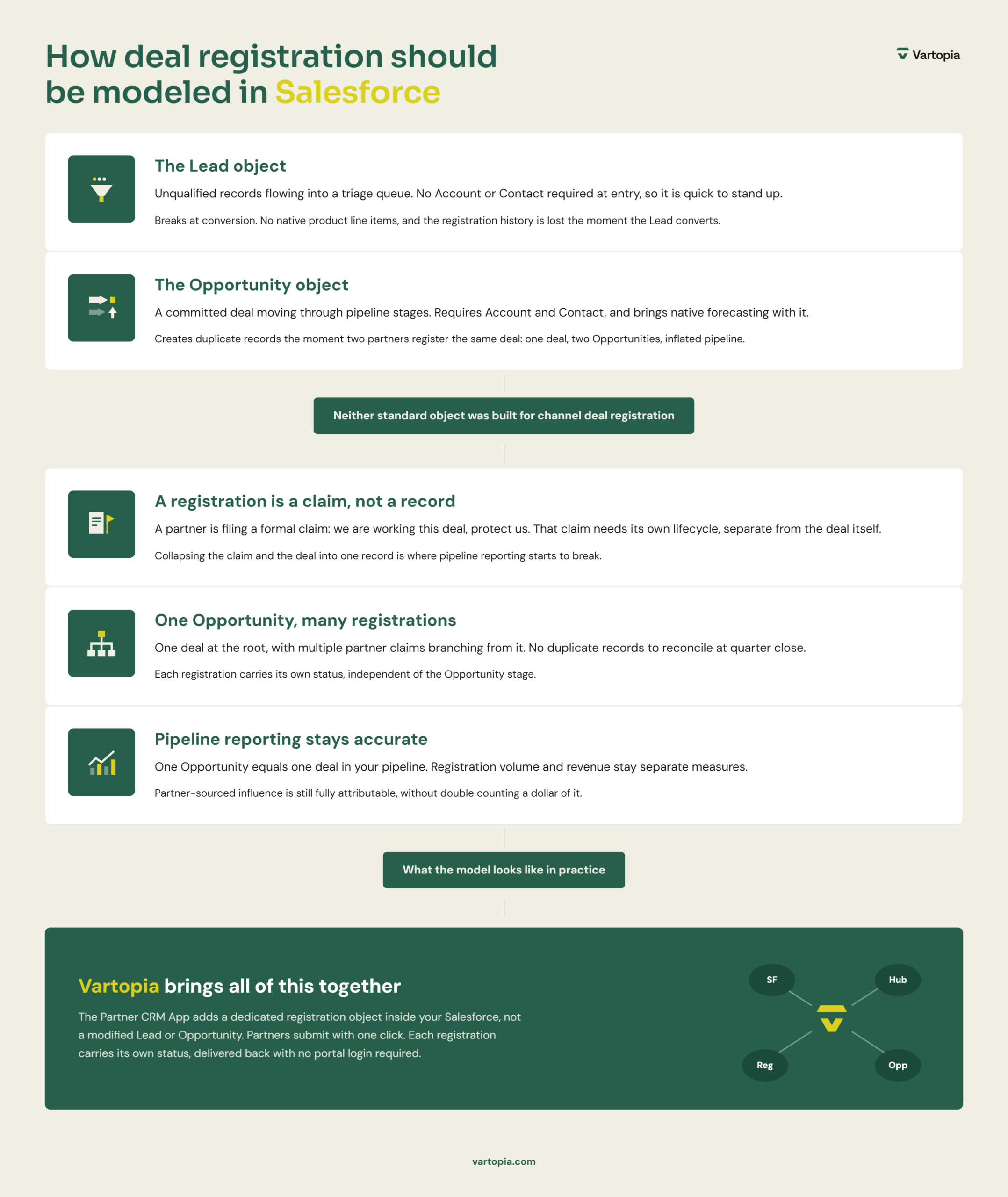
The architecture that actually works treats a registration as its own dedicated registration object that references an Opportunity rather than replacing it.
Instead of forcing registrations into standard Lead or Opportunity records, the registration exists as its own object with its own approval process, status lifecycle, and relationship to the partner that submitted it.
One Opportunity can then support multiple registrations, each carrying its own status and partner attribution without affecting the Opportunity stage. It’s not a workaround. It’s the right way to model deal registration.
Vartopia, for instance, implements this as a strict one-Opportunity-to-many-registrations relationship, where each registration carries its own status lifecycle independent of the Opportunity stage. The two run in parallel, mapped to each other, but never collapsed into a single record.
How the Three Models Actually Compare
The table below shows where each approach holds up and where it doesn’t across the decisions that matter most to channel ops and RevOps teams.
| Lead | Opportunity | Dedicated Registration Object | |
|---|---|---|---|
| What it represents | An unqualified person or company | A deal your team has committed to work | A partner’s claim on a specific deal |
| Requires Account/Contact at submission | No | Yes | No |
| Effect on forecast | Disrupts lead assignment and ownership | Inflates open pipeline before qualification | None until approved and linked to an opportunity |
| Approval, denial, and expiration | No native state; denial has nowhere to go, expiration isn’t modeled | Denials become junk stages or get deleted; expiration isn’t modeled | Full native lifecycle: submitted, approved, denied, returned, expired |
| One deal, multiple vendors or partners | Creates duplicate leads | Creates duplicate opportunities, or overwrites a field | One opportunity, many registrations; duplicates surface instead of colliding |
| Pipeline inflation risk | Medium | High | Low |
| Channel conflict detection | Manual | Manual | Automated if modeled correctly |
| Partner attribution and status visibility | Survives only if fields are hand-mapped before conversion; partner gets no status back | Tied to one field on one opportunity; partner gets no status back | Preserved on its own record; partner sees accurate status |
What It Looks Like When the Data Model Is Actually Right
When registration is modeled as its own record type linked to an Opportunity, several things that currently require manual intervention start happening on their own.
Channel conflict becomes visible at submission, not at QBR. If two partners register the same deal, the system flags it immediately because both registrations point to the same Opportunity. You’re not comparing two separate CRM records by hand. The conflict surfaces in the data instead of in a heated conversation between channel managers.
Registration status and Opportunity stage move independently. A registration can be Approved while the Opportunity is still in Qualification. A registration can Expire while the deal is still active. Those two facts can be true at the same time, and a well-modeled system holds both without one overwriting the other. The vendor sees the Opportunity stage. The partner sees their registration status. Neither bleeds into the other.
Partners get accurate information back. When registration status lives as a field on an Opportunity record, what the partner sees depends on what stage the Opportunity happens to be in, which may have nothing to do with their specific claim. When registration has its own record, the partner sees exactly where their submission stands, not a generic pipeline stage that belongs to the vendor’s internal process.
Status updates reach partners without adding friction. Accurate status is only useful if it actually reaches the partner. Vartopia handles this through EZ Update, a tokenized email link that lets a partner view and update their registration without logging into a portal. The status stays current on both sides without pulling the partner back into another system.
Pipeline reporting stops lying. One Opportunity is one deal, regardless of how many partners registered against it. Volume metrics such as how many registrations came in, from which partners, through which programs, live on the registration records. Revenue metrics live on the Opportunity. The two stay connected but don’t contaminate each other.
This is the architecture Vartopia’s Partner CRM App implements in practice. It adds a custom registration object inside the partner’s own Salesforce instance rather than modifying the standard Lead or Opportunity objects. A partner submits an Opportunity with one click. That Opportunity doesn’t get duplicated or overwritten. The registration record carries its own lifecycle alongside it.
The Question Was Never Leads or Opportunities
The Lead vs. Opportunity debate has been running in channel teams for over a decade because Salesforce never resolved it and most vendors never questioned whether the framing was right.
Both options work well enough to get something live. Neither works well enough to give you clean pipeline data, accurate partner-side status, and channel conflict detection that doesn’t depend on someone running a manual check before every board meeting.
The issue isn’t which standard object you configure. It’s that standard objects were built for a direct sales motion, and deal registration isn’t a direct sales motion. It’s a partner making a claim, a vendor adjudicating it, and both sides needing accurate information about where that claim stands, independent of where the underlying deal stands in the pipeline.
When you design for that reality instead of working around it, the Lead vs. Opportunity question answers itself. You don’t need either one as the home for a registration. You need a registration record that sits alongside an Opportunity, not inside it.