That’s not a rare edge case. It’s the default condition for most channel programs, because most account mapping tools were only ever built to see one vendor’s slice of one partner’s activity. This piece covers what channel account mapping actually is, why the single-vendor version of it misses so much, and what changes when the view runs across vendors instead.
What Is Channel Account Mapping?
“Account mapping” usually means one specific thing in B2B software: two SaaS companies comparing customer lists to find overlap, so their sales teams can co-sell into shared accounts. That’s a real category. It’s not what this is about.
Channel account mapping is a different problem that happens to share a name. It’s how a vendor turns a target-account list into partner action: the vendor identifies the companies that fit its ideal customer profile, shares that list with its channel partners (VARs, resellers, MSPs), and tracks which partners move on which accounts. Done well, it turns a vague incentive program into something a partner can act on, account by account, inside the same system where they already register deals.
The distinction matters because it decides what “working” means. Co-sell account mapping measures overlap between two companies’ customer bases. Channel account mapping measures something else: whether a vendor’s own partner network is actually moving on the accounts the vendor cares about, and whether that movement shows up as a registered deal.
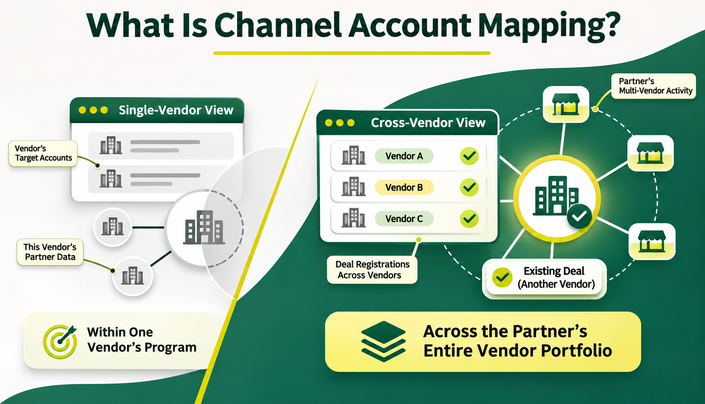
Most account mapping tools built for this channel-specific version are still built to compare one list against one dataset: a vendor’s target accounts against that same vendor’s own partner and deal-registration data. That’s a legitimate capability. It helps a vendor see which of its own partners are already engaged with a given target.
The limit here is scope, not execution: a tool can only match against the data it can see, and one vendor’s deal registration history covers just a fraction of what a partner has actually done across the rest of its book.
Why Single-Vendor Account Mapping Falls Short
A reasonably active channel partner doesn’t work with one vendor’s program. They work with 50, sometimes 100, at once. Each one hands over its own target-account list, its own incentive structure, its own portal to check.
No partner sales rep can hold 50 vendors’ target lists in their head. In practice, they default to working whichever vendor was loudest most recently, not necessarily the one whose target list actually overlaps with an account the partner already has traction on.
That’s the real cost of single-vendor account mapping. A partner can’t easily prove to any one vendor that they’re already working that vendor’s list, and once attribution breaks like that, it breaks in a predictable direction:
- The vendor can’t defend the channel-marketing spend behind the program to its own CFO
- Partner-marketing budgets get cut
- Partner reps get fewer leads to work
- They default to whichever vendor is loudest, and the cycle starts over
A single-vendor tool was never built to see outside its own program, which is exactly why it can’t interrupt that cycle.
Here’s what that looks like in practice. A vendor uploads a target account to its own program. A partner it’s counting on to chase that account already has a deal registered against it, through a completely different vendor, filed months earlier. The vendor’s own process has no way to surface that, so it asks the partner to chase the account cold. The partner looks unresponsive, the target list looks like it isn’t landing, and neither read is true. The gap is structural, not a performance problem on either side.
How Channel Account Mapping Works Across Vendors
Closing that gap means seeing across vendors, not just within one. That’s what Vartopia’s Account Mapping module is built to do: it runs on a cross-vendor dataset, not a single vendor’s own records.
A vendor uploads a target-account list the same way as with any other account mapping tool. What’s different is what happens next: the list gets checked against a partner’s deal registration history across every vendor that partner is authorized to work with, not just the one who uploaded it.
Within the module, this is its own view, separate from the reports that simply check whether this vendor’s own partners have registered a deal against this vendor’s own targets. That view is the one doing the cross-vendor work: it surfaces a target account the moment a partner has relevant deal registration history anywhere in their authorized portfolio.
This sits inside Vartopia’s broader network of partner users worldwide, not a single vendor’s slice of it. That’s what makes cross-vendor matches possible at all.
| Single-vendor account mapping | Cross-vendor account mapping | |
|---|---|---|
| Data source | The uploading vendor’s own deal registrations only | The partner’s deal registration history across every vendor they’re authorized to work with |
| What an untouched account means | Nobody has engaged it, as far as the tool can tell | Nobody has engaged it anywhere the tool can see, a much stronger claim |
| What a match reveals | A partner is working with this vendor on this account | A partner is already in motion on this account, through a different vendor relationship |
| What it makes measurable | Whether a partner closed a deal from cold outreach | Whether a partner closed a deal from a match they already had |
A Channel Account Mapping Example
Take a vendor with a target list of fifty accounts in, say, mid-market manufacturing. One of those accounts already has a deal registered against it, not with this vendor, but with a different vendor on the network, filed months earlier by a partner authorized to work with both.
Under single-vendor account mapping, that account shows up as untouched: a cold lead, for whichever partner happens to look at it next. Under cross-vendor account mapping, the account surfaces as already in motion, with the partner who’s engaged with it identified automatically, no extra step required on the partner’s side beyond the registration they already filed.
Visibility Has Limits, Even Across Vendors
Cross-vendor matching does not open visibility across the whole network. It does one narrow thing: it checks whether a partner already authorized to work with a specific vendor has engagement history with a given account somewhere else in their portfolio. A match surfaces only where that authorization already exists.
What it doesn’t do matters just as much:
- It doesn’t show one vendor another vendor’s pipeline
- It doesn’t show one partner another partner’s activity
The underlying deal-registration history is platform-wide, but what gets through to any single vendor or partner is gated by the authorization relationships that already exist between them. A vendor sees matches only among its own authorized partners. A partner’s history only surfaces through a vendor relationship it has already agreed to.
It’s also worth being direct about what account mapping doesn’t fix:
- A poorly built target-account list
- A weak incentive program
- How much effort a partner rep actually puts into an account
- Sales cycle quality, end-customer demand, and competitive pressure once a deal is engaged
It gives a vendor and its partners a shared, accurate starting point. It doesn’t close deals for anyone.
What Changes for Channel Marketing Leaders
For a channel marketing leader, the practical shift is attribution, and attribution is the thing this role gets measured on even when the underlying channel program is working.
Before cross-vendor matching, an ICP list handed to partners is a one-way communication: you share it and wait, with no reliable way to tell whether silence means nothing happened or something happened somewhere you can’t see.
After it, the same list is something you can actually report on:
- Which accounts got claimed
- Which partners engaged them
- Whether that engagement turned into a registered deal
That’s the difference between telling your VP of Sales “we shared the list” and telling them forty of two hundred target accounts are already in motion, through these specific partners, with registered pipeline behind it.
It also changes what you reward. A program that only pays out for closing cold outreach can’t see, let alone reward, the partner who already had the relationship and just needed the account surfaced. That’s a genuinely different behavior to encourage than rewarding cold prospecting, and a single-vendor tool has no way to spot it.
The Takeaway
Ecosystem intelligence, the idea that a partner’s full set of vendor relationships should inform how a vendor’s program runs, is easy to agree with and hard to act on. Most account mapping tools can’t act on it, because they’re built to see only the vendor’s own slice of a partner’s activity. Channel account mapping that runs across vendors is what acting on it actually looks like: the account list a vendor builds stops being bounded by its own data, and starts reflecting what a partner already knows from working the rest of its book.
For a vendor evaluating whether their current account mapping process is doing this or just looking like it is, the test is simple: ask whether an “untouched” account on your list is untouched because nobody’s engaged it, or because your tool can’t see where it’s already being worked.

See how Vartopia’s Account Mapping module can close the gap your own tools can’t see. Book a demo