That’s fine if a partner works exclusively with you. Very few do.
Most enterprise partners carry several vendor relationships at once, and the three textbook types of channel conflict don’t disappear when a partner’s book gets bigger. They compound: a partner isn’t dealing with one version of vertical, horizontal, and multi-channel conflict, but as many versions as they have vendor relationships, each running on a different clock.
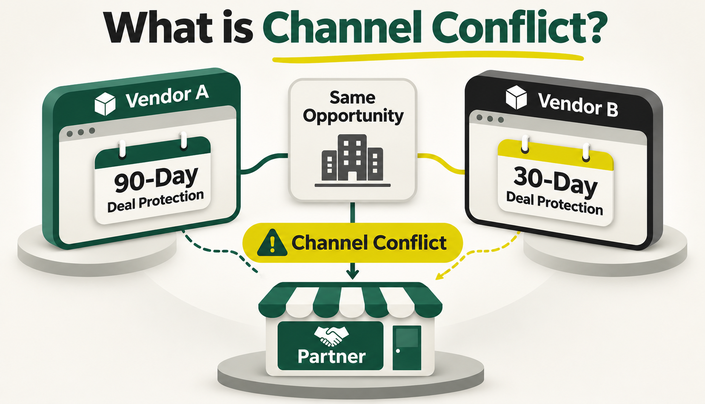
A 90-day deal protection window from one vendor and a 30-day window from another aren’t separate policies to the partner. They’re the same opportunity, protected under one set of rules and exposed under the other, at the same time.
This piece isn’t about which textbook type of channel conflict a deal falls into. It’s about what happens when a partner runs more than one of each at the same time.
What Is Channel Conflict?
Channel conflict happens when two parts of the same selling ecosystem compete for the same deal instead of working the same side of it. It shows up in three recognizable patterns.
Vertical conflict happens between levels: a vendor’s own direct sales team working the same account as one of its partners.
Horizontal conflict happens between partners at the same level: two resellers chasing the same prospect, usually because neither one knew the other was involved.
Multi-channel conflict happens across different channels: a marketplace listing undercutting a reseller’s quote, or a partner’s prospect converting through a vendor’s own website before the partner gets credit.
Most vendors recognize these patterns. Fewer notice what happens when more than one of them hits the same partner, across more than one vendor, at the same time.
The Channel Conflict Problem No One’s Writing About: Different Rules, Same Partner
Most channel conflict advice is written from inside a single vendor’s program: set clear rules, register deals early, keep pricing consistent. That works inside that one program.
It assumes a partner’s world is as tidy as one vendor’s policy document. For a partner selling several vendors’ products, it isn’t.
Here’s the version of channel conflict that actually eats a channel manager’s week:
- A partner has one live opportunity touching two vendor relationships, say a cybersecurity platform and the managed services layer on top of it
- Vendor A protects a registered deal for 90 days
- Vendor B protects it for 30 days, and starts that clock at the first outbound email, not the first registration
- The partner registered correctly with both vendors
- By Vendor B’s clock, protection has already lapsed. By Vendor A’s, it hasn’t
Nobody broke a rule. Each vendor’s policy is internally consistent on its own. The conflict lives in the gap between two policies that were never designed to talk to each other, and the partner is the only one standing in that gap.
That’s a different problem than the one most channel conflict guidance solves. Clearer rules inside one program don’t help, because the partner isn’t confused about any single vendor’s rules. They’re trying to reconcile several sets of correct rules that simply don’t match.
How Channel Conflict Hurt Partner Trust, Not Just One Deal
When a partner loses a deal to channel conflict, the immediate cost is easy to see: one deal, one commission, one frustrating call with a channel manager.
The higher cost shows up later, quietly:
- Three months on, the same partner has a new opportunity
- They decide, without saying so out loud, which vendor gets it first
- Partners learn fast which vendor relationships are predictable and which ones carry risk they can’t plan around
- A partner burned by a registration dispute rarely files a complaint. They just route ambiguous deals to the vendor they trust, and hold back from the one they don’t
Pipeline doesn’t disappear all at once. It thins out, deal by deal, as partners make small, rational decisions about where their time is safest spent.
For a vendor relying on indirect sales, that’s the real cost of channel conflict: not the deal you can point to, but the deals you never hear about because a partner stopped bringing them.
Why Single-Vendor Fixes Don’t Solve Channel Conflict Across Multiple Vendors
The standard channel conflict playbook is familiar: define clear rules of engagement, register deals early, align direct and partner compensation, keep pricing consistent across channels, and give partners visibility into pipeline status. Each of these genuinely helps, inside the program that builds them.
None of them reach the problem above, because that problem doesn’t live inside any single program. A vendor can run a well-designed deal registration process and still be one of several vendors whose rules a partner has to reconcile. Fixing your own rules doesn’t help a partner who’s also working with other vendors whose rules are equally well designed, and still don’t match yours.
This is also why the usual prevention advice, pricing discipline, tiering, territory segmentation, solves a different problem than the one a multi-vendor partner is actually describing when they say a program feels hard to work with. The friction isn’t bad policy. It’s the absence of anything that spans policies.
What Actually Helps: Making Your Own Program Easy to Read
This doesn’t require the vendors a partner works with to agree on one shared rulebook. That isn’t realistic, and no single vendor can make it happen on its own. What a vendor can control is how legible its own program is: whether partners and the vendor’s own channel team can see where a registration stands without a phone call or a spreadsheet.
That’s what Vartopia’s deal registration management is built to do on the vendor side:
- One place to manage registrations and see where each one stands
- Pipeline visibility across your partner program, so you can see which partners are registering what
- A standardized status alongside your own status vocabulary, so your program’s terms stay intact while registrations roll up cleanly for reporting
- Extension requests and close-date updates handled from an email link, with no login required
It doesn’t rewrite your rules of engagement, and it doesn’t change anyone else’s. What you gain is a program partners can trust to be current and predictable, which is what they weigh when deciding which vendor gets an ambiguous deal first.
A Self-Check for Partners Juggling Multiple Vendor Programs
This checklist is written from the partner’s seat. Share it with your partners to find out where your program’s rules collide with those of the other vendors they work with.
Before assuming a single conflict incident was a one-off, it’s worth checking whether the pattern runs deeper.
- Do you know, right now, how many of your vendor programs have different exclusivity windows for a registered deal?
- If two of your vendor relationships touched the same account today, could you say with confidence which one’s rules take priority?
- Have you ever found out a deal’s protection had lapsed only after losing it, rather than before?
- Do you track registration status yourself, separately from each vendor’s portal, because you don’t fully trust any single one to reflect reality?
- Has a channel conflict dispute ever cost you more time to resolve than the deal itself was worth?
A yes to more than one or two of these says less about a single bad incident and more about a structural gap that keeps producing them.
Conclusion
Channel conflict isn’t going away, and it isn’t only a sign that something’s broken. It’s a normal consequence of partners working across an ecosystem rather than inside one program. The vendors that handle it well aren’t the ones with the strictest rules. They’re the ones that make it easy for a partner to know exactly where they stand, even when the rules creating the confusion didn’t come from them at all.

If you suspect partners are holding back deals because your program is hard to read, the Vartopia team can talk through where things stand. Book a demo