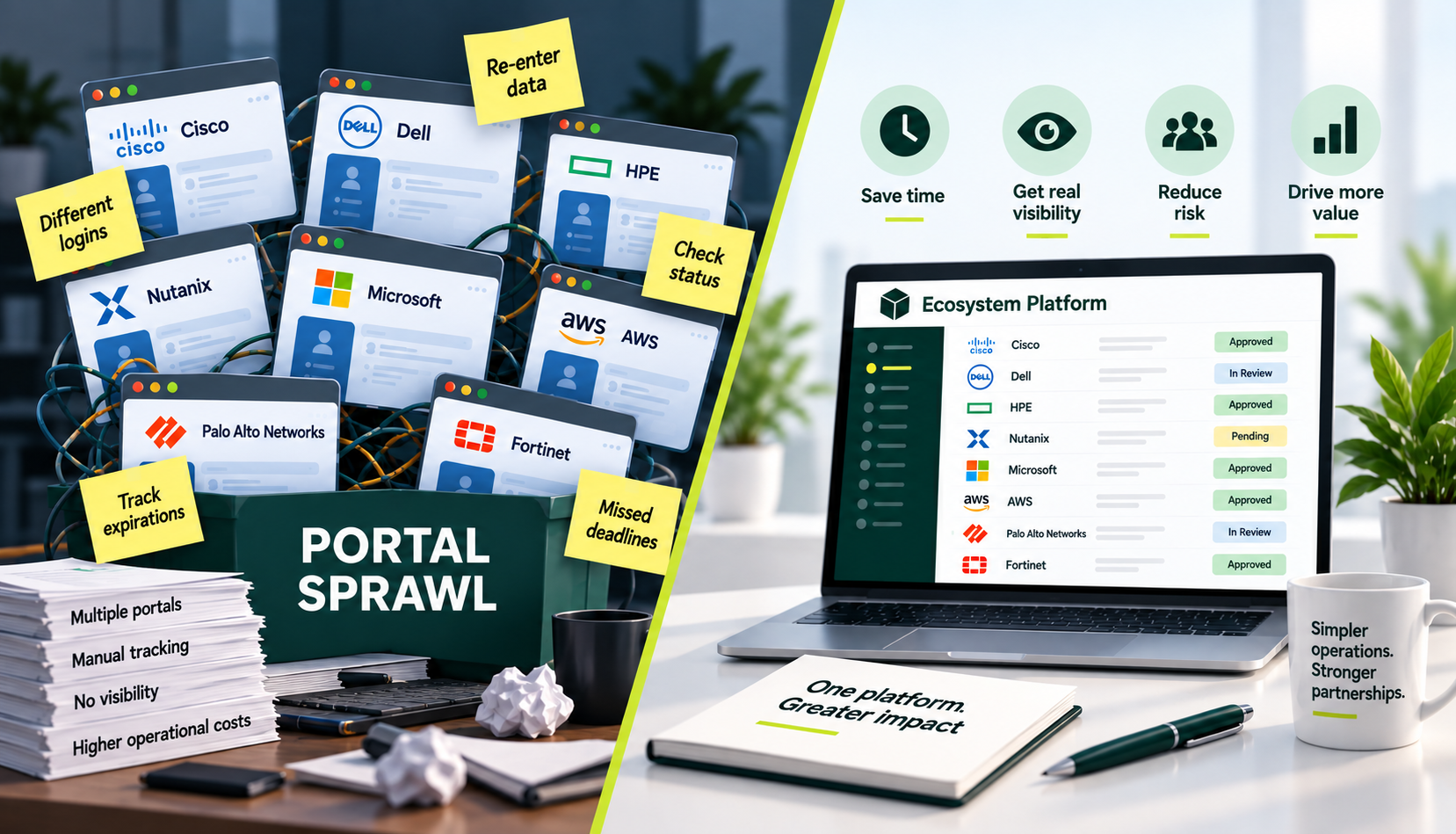

Multi-vendor deal registration gives partners a single place to submit and manage opportunities across every vendor they represent, while each vendor keeps operating under its own program rules.
Does that mean replacing your PRM? Does it expose your pipeline to competing vendors? Could it actually increase channel conflict instead of reducing it? And how does any of this work in practice?
Here’s what multi-vendor deal registration actually is, how it differs from a PRM’s own deal registration, and why more vendors are starting to treat it as a way to remove partner friction without changing the rules that govern their programs.
Is This the Same as a PRM’s Deal Registration?
No, and this is usually the first objection a vendor raises, fairly.
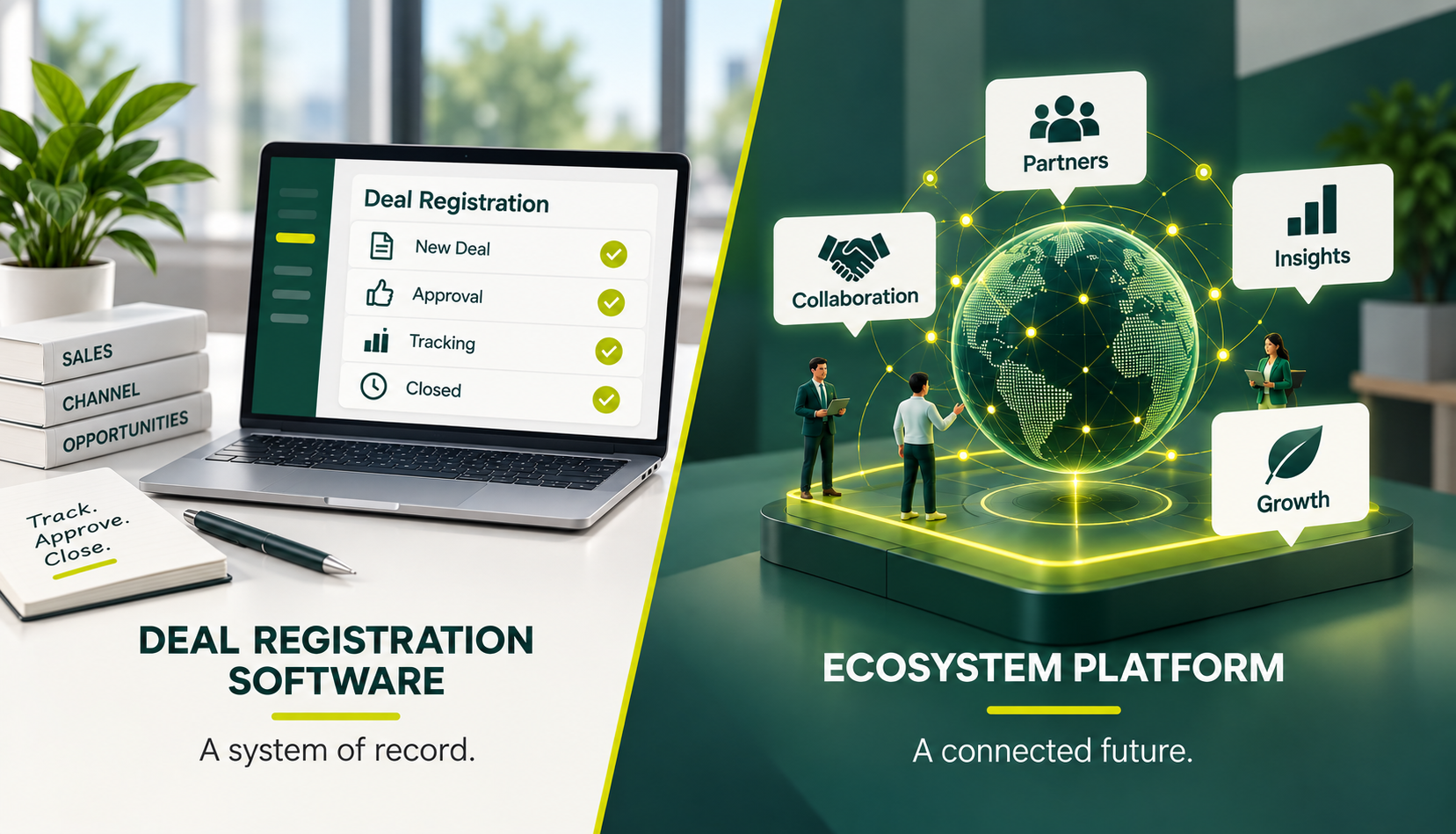
A PRM’s deal registration module lives inside your program, for your partners, under your rules. Multi-vendor deal registration is a layer a partner uses across many vendors at once. It sits alongside your PRM. It doesn’t replace it.
The real question underneath that objection is usually: if a partner registers through a shared platform, can my competitors see it?
They can’t. Your data, your workflow, your approval rules stay yours. What changes is how the partner submits and tracks, not who owns what happens after.
How Multi-Vendor Deal Registration Works
With that settled, here’s what actually happens when a partner registers a deal.
The process looks like standard deal registration, with one difference: the partner submits once, not five times.
- The partner identifies an opportunity, same as always.
- They submit through one interface, listing every vendor and product involved.
- Each vendor evaluates the registration under its own criteria and timeline. Nothing about your program changes on your end.
- Status flows back to the partner in one dashboard. Approved with you, pending with another vendor, denied with a third. All visible at once, instead of five separate logins to find out.
- Deal protection still runs on your terms, for the length of time you already protect a registration.
The piece doing the real work here is a mapping layer between each vendor’s status language and a common set of stages the partner can actually read. You might call a stage “Pending Sales Review.” Another vendor calls the same idea something else. The partner shouldn’t have to learn either vocabulary. They just need to know where the deal stands.
Does Multi-Vendor Deal Registration Increase Channel Conflict?
No. If anything, it lowers the odds of two partners colliding on the same account.
Channel conflict happens when two partners, or a partner and your own sales team, chase the same customer without knowing it. Deal registration exists to prevent exactly that.
But protection only works if the registration happens.
A meaningful share of qualified opportunities never get registered at all. A lot of that is friction, not neglect. A partner juggling five portals for one deal tends to register with whoever’s form is fastest, and skip the rest.
The real challenge isn’t seeing too much. It’s not seeing enough. Because every registration is visible in one place:
- The same deal can’t get registered twice without it showing up immediately
- That’s what actually catches conflict, not just the promise of it
- A multi-vendor layer doesn’t touch your approval logic
- It just makes registering with you as easy as registering with anyone else
Why Vendors and Partners Both Benefit
For Partners: fewer logins, less repetitive data entry, one place to check status instead of five. That protection is also what secures their margin on a deal they’ve already invested time in, which is the actual reason deal protection matters to a partner in the first place, not just the convenience of it. A partner who has to open five portals to check five registrations often just doesn’t, until something forces the issue.
For Vendors: the benefit shows up downstream. Easier registration means partners register more of what they’re actually working, not just the deals big enough to justify the hassle. That’s a fuller pipeline view, not just the top-heavy slice that made it through.
Fewer status-check emails land in your channel managers’ inboxes too, since partners aren’t waiting on a reply to know where things stand.
None of this requires a new approval process. Registrations sync through your existing CRM, in the same shape they’d arrive in if the partner had used your own form.
What Multi-Vendor Registration Doesn’t Fix
It’s worth being honest about where this stops helping.
- It doesn’t speed up your approval process. If your team takes a week to review a registration today, a faster submission just means partners find out the same answer, sooner, but still after a week.
- It doesn’t override your rules. Duplicate detection, territory conflicts, tier eligibility: all of that still runs through your logic. A multi-vendor layer gets the registration to you faster. It doesn’t decide anything on your behalf.
- Easier submission can mean lower-quality submissions. If registering takes ten seconds instead of ten minutes, some partners will register early, on deals that aren’t real yet. Worth watching as a metric, not assuming away.
- It takes some setup on your end. Your program’s stages and rules need to map into the shared status view partners see. That’s a one-time lift, not a redesign, but it isn’t nothing.
- It doesn’t guarantee adoption. A partner used to spreadsheets and email won’t switch the day a faster option shows up. The tool removes friction. It doesn’t do the change management for you.
None of this is a reason to skip multi-vendor registration. It’s a reason to pick a platform built around these limits instead of ignoring them.
Multi-Vendor Registration on an Ecosystem Platform
Partners work across an ecosystem of vendors, not inside any single one’s portal. They’re jumping between programs, logins, and rulebooks all day, every day. Any platform trying to fix deal registration has to start from that reality, not fight it.
Vartopia is one of the platforms built around that reality instead of working against it.
For Partners, that means the Vartopia Hub. It’s free, and it gives a partner one login and one dashboard across multiple vendor programs they work with, instead of a separate portal per vendor. Registering with you shouldn’t be the slow option just because it’s the fourth login of the day.
For Vendors, it means Vartopia extends your existing PRM into that shared partner experience, rather than replacing it. Your approval rules, your CRM, and your program stay exactly as they are. That includes maintaining the status-mapping layer mentioned earlier, so partners get one dashboard without your team building a translation layer between every vendor’s vocabulary and your own.
Distributors get the same benefit one level up, submitting on behalf of the partners they support through that same consolidated view.
Why the Channel Is Moving Towards Multi-Vendor Experiences
Deal registration is really just the most visible symptom of something bigger. Vendors have spent two decades building programs and portals around themselves. Partners were never actually organized around any one vendor.
Analysts tracking the channel have started saying this plainly. Distributors, once treated as a pass-through layer between vendor and reseller, are increasingly described as the ones orchestrating the ecosystem around them, not just moving product through it.
None of that is really about registration forms. It’s about where partners actually live: inside an ecosystem of vendors, not inside any single program. The vendors who build, or choose, for that reality tend to see it show up first in a number most programs never check: how many partners are quietly registering somewhere else because it was easier.